Wednesday, October 12, 2011

10 Principles for Assisting Reading. 8. Reflection

At the end of the story ask your child what he/she had achieved during the reading.

The two stars and a wish is a good technique to promote self-regulation. The two stars are two goals that your child has achieved. One way to view this is to differentiate the two stars into a product (something gained) star and the other a process star. In other words, I give myself a star because I found out that ... or that I enjoyed the story because.... The process star relates to the process of reading itself. How did I read? I used the reread strategy when I was stuck on a word.

The wish refers to what the reader wants to achieve in future reading episodes. A wish sets the next goal to be achieved during the next guided reading session.

Friday, October 7, 2011

10 Principles for Assisting Reading. 7. Relate

After the reading the parent/guide should ask the child about how he/she enjoyed the book/passage. Relate the story to the child's own experiences. Place the child into the shoes of the main character by asking, what he/she would have done in the same situation. Ask the child to imagine what it would have ben like to have been in the same situation.


Have the child retell the story or passage. This is an important stage as it helps the child to reorganise and recode the information in the passage. Check that the child is ordering the events correctly and that they have identified all the main ideas. Ask what parts he/she liked the best and why. Don't make this too formal - just relax and share thoughts and ideas. The parent/care-giver should also relate the story to things that happened to them but keep it conversational.

Ask the child if his/her predictions about the story were correct or were the events of the story different to what was imagined. How was it the same and what was different?

 It is a time that the parent and the child should be looking forward to each day. The most important thing is that this should be a fun time for both!

Thursday, October 6, 2011


This Question was recently posed by Assoc. Prof. Ruth Fielding-Barnsley in her key note address at our recent 2011 Conference -  Include and Impact.


What do you think?

Wednesday, October 5, 2011

10 Principles for Assisting Reading. 6c Scaffolding - Praise

Throughout the world it has been consistently reported that guided reading sessions often end in frustration and anger. One of the factors leading to disappointment is when guided reading sessions focus on the reader being exact rather than on reading for meaning and enjoyment.


The strategic use of praise can reverse this trend. Appropriate praise can provide a positive spin on the guided reading session and prevents this negative situation from developing.  However, not all forms of praise are effective. For example, praise can be ineffective when it is not very specific. For praise to be useful it must be immediate and it should give exact performance feedback so that the reader can lean from the comments. This promotes intrinsic motivation, whereby, the reader is given the information needed and encouraged to develop mastery over the reading process. This should be a reward in itself and it should be acknowledged. In other words, when the reader's efforts are acknowledged while gaining reading competence he/she will be encouraged to develop a sense of pride and achievement.

Instead of 'error spotting' the reading guide should always look for the positives. After all, children usually do more of the right sorts of things while reading, even when making errors. For example, when the reader reads, "The boy hopped on to the house and rode down the street." Respond at the end of the sentence with,  "That was a good try, this word does look like the correct word  and it starts with the letter 'h' and ends in 'e' but it does that word make sense in this sentence?" Praise the correct response with, "I like the way that you self-corrected that word because the sentence now makes sense."

At the end of the reading session ask the child to tell you what he/she learned and what was achieved in the session. Say, "What was the thing that you were happiest about while you were reading?" The main principle is to move from giving praise to encouraging self-praise. This can be enhanced by having the child set a reading goal before reading, e.g., "Today I will try and reread the sentence when I get stuck."

Tuesday, October 4, 2011

10 Principles for Assisting Reading. 6b Scaffolding

In the last two blogs we discussed the scaffolding required for two types of miscues that are typically made during guided reading.

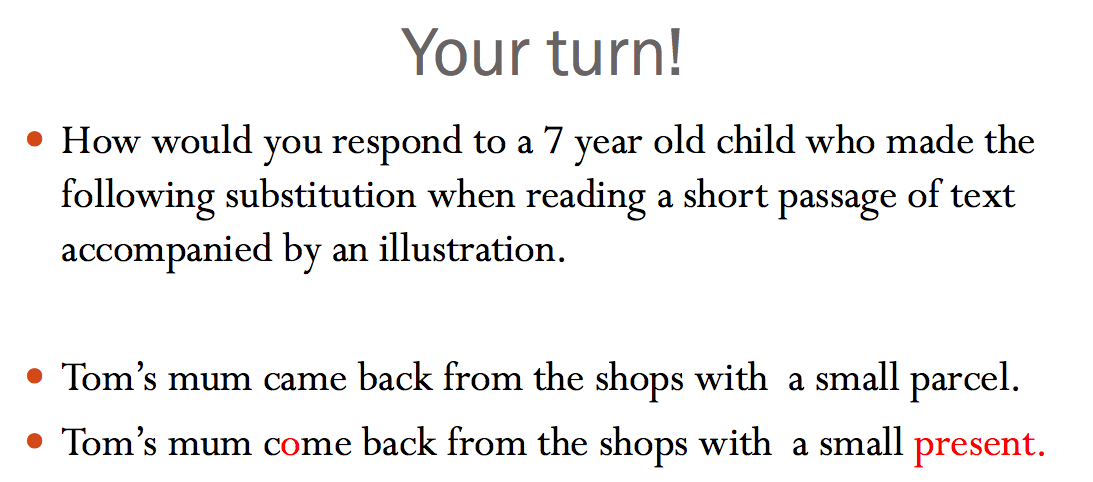
The third situation is rather simple, it does not require any intervention. When the reader makes an error and the meaning is not lost then do not respond. This type of miscue is common to most good readers and is an indication that the reader is reading actually processing for meaning. It stands to reason that when a reader makes an error that has almost the same meaning as the targeted word then the reader has understood the message conveyed by the author. Meaning is the most important consideration because the purpose of reading is to understand. By ignoring this type of miscue reading risk-taking and fluency will be encouraged. This is not normally a problem because as the reader becomes more confident this type of miscue will diminish, but not completely. Competent readers make this type of miscue more often that we realise. Normally competent readers monitor their reading by asking themselves, "Does this make sense? or "Does this sound right?" If the answer to these two questions is yes the reader will continue the reading without any loss of meaning.


If the reading is interrupted the reading guide may be in danger of giving a wrong message. The reader should be sampling the text and touching the fewest bases so that working memory can be used effectively without being overloaded. On the other hand, if too much emphasis is placed on exactness the danger is that reading will slow down, risk-taking will be stifled, meaning will be lost, and working memory will not function efficiently.